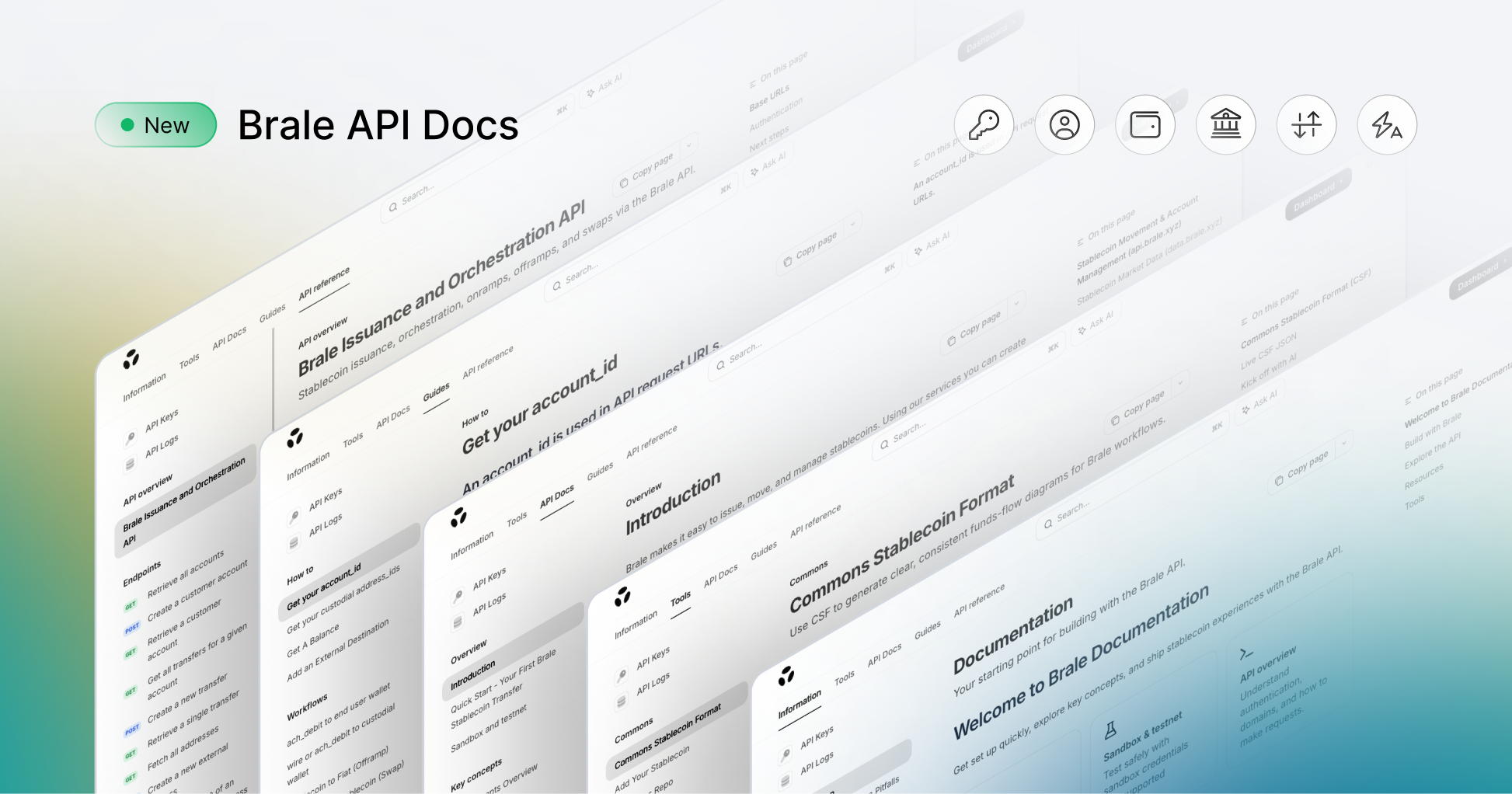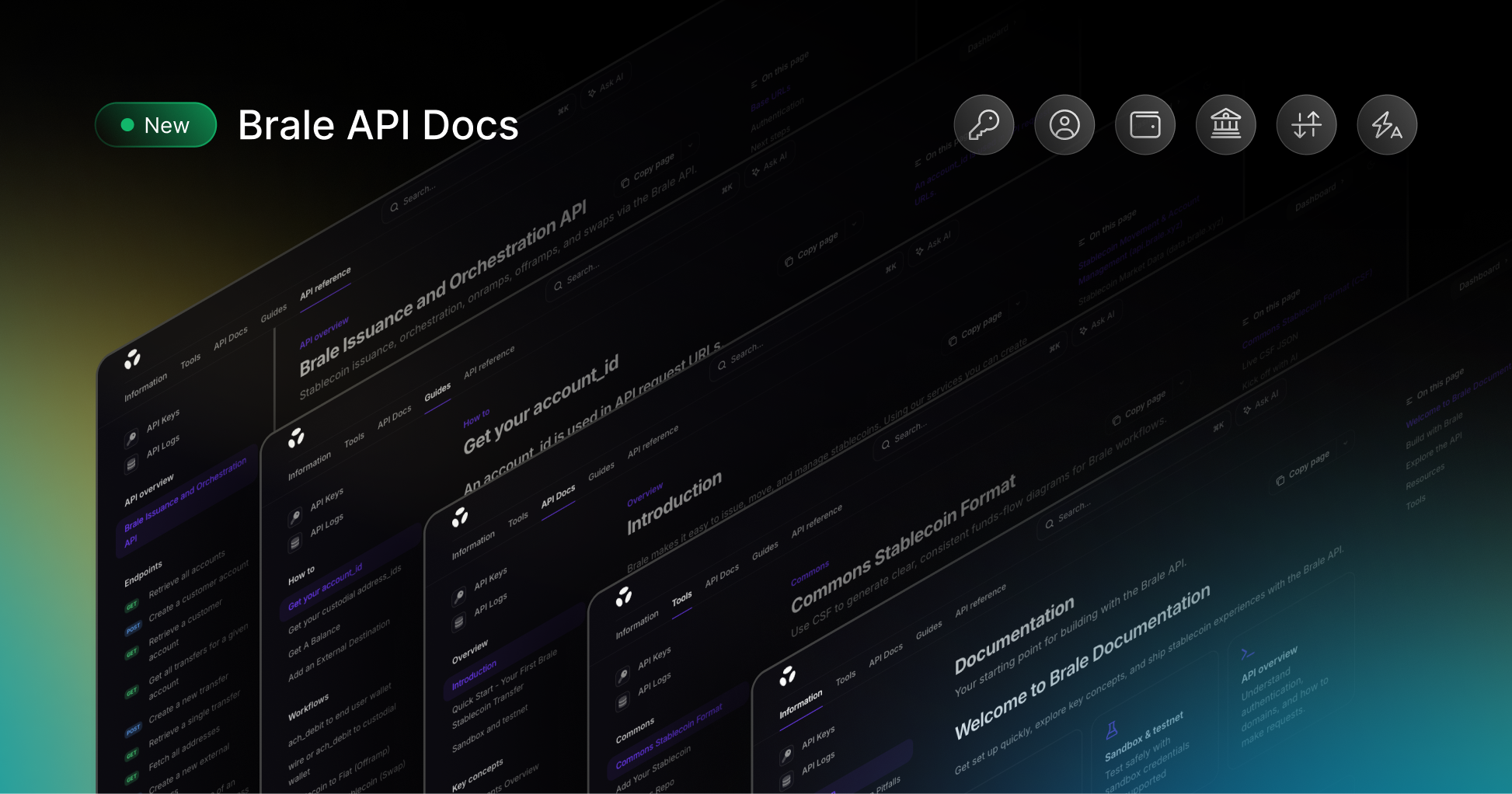

We've launched the Brale MCP Server at https://mcp.brale.xyz.
Built as a controlled, scoped interface to the Brale API via the Model Context Protocol (MCP), it allows AI agents and MCP-compatible developer tools to execute specific Brale operations using standard authentication and permissions.
Why we built it:
AI tools are getting closer to production systems.
Engineers already use them to inspect responses, validate parameters, and test behavior directly from their editor. Many are evolving from assistants into agents that trigger real actions through APIs.
When those systems issue and move stablecoins, the margin for error disappears.
A malformed request isn't just a failed test. It's money.
The MCP Server connects those environments to Brale's regulated infrastructure, deliberately and with guardrails intact, so AI systems can execute stablecoin operations without compromising control.
From intent to API call
With the new Brale MCP Server, you can move from intent to a correctly structured API request in seconds.
Instead of searching documentation, wiring requests manually, and validating parameters endpoint by endpoint, you can ask your MCP client to perform a specific action.
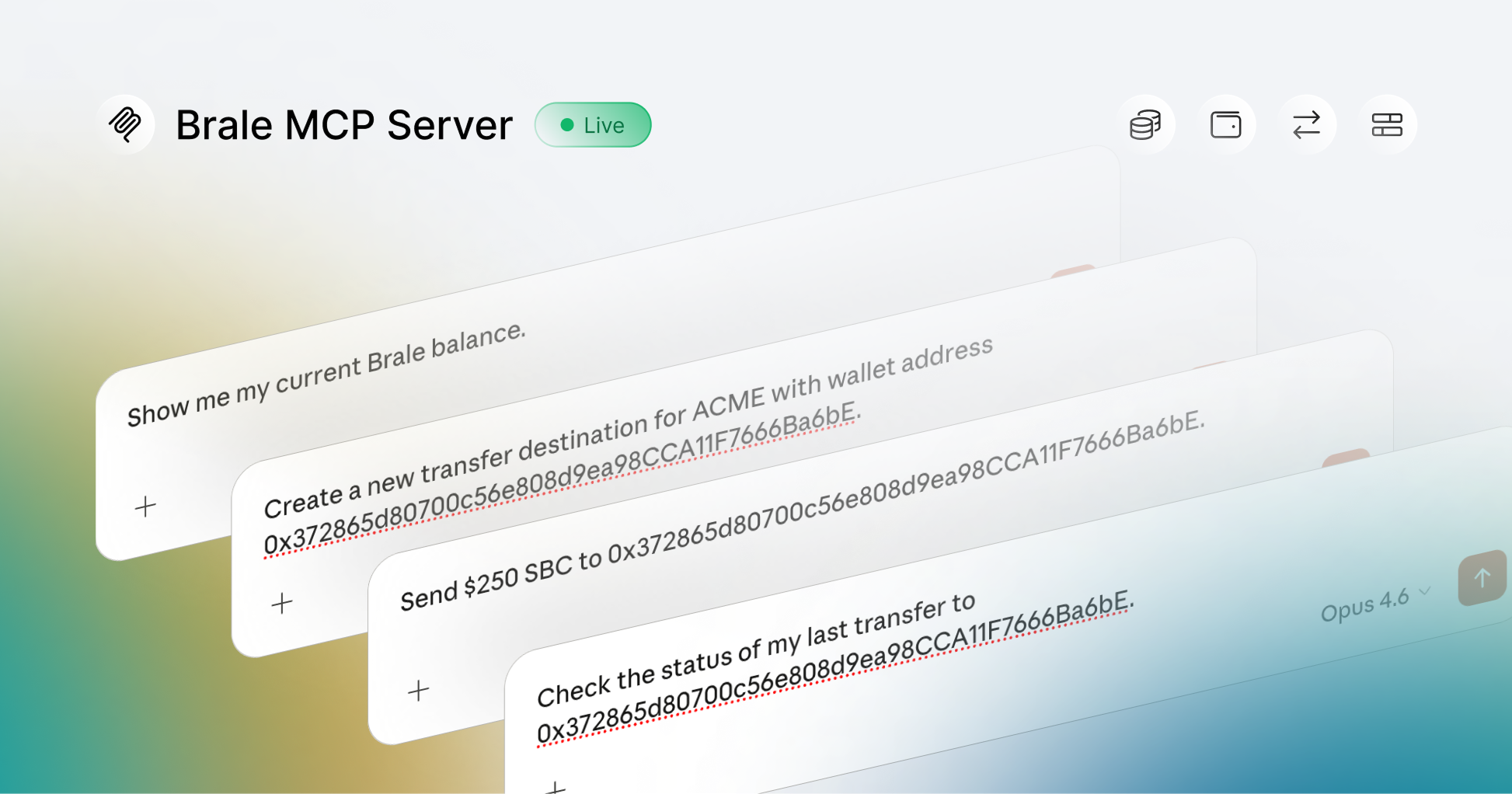
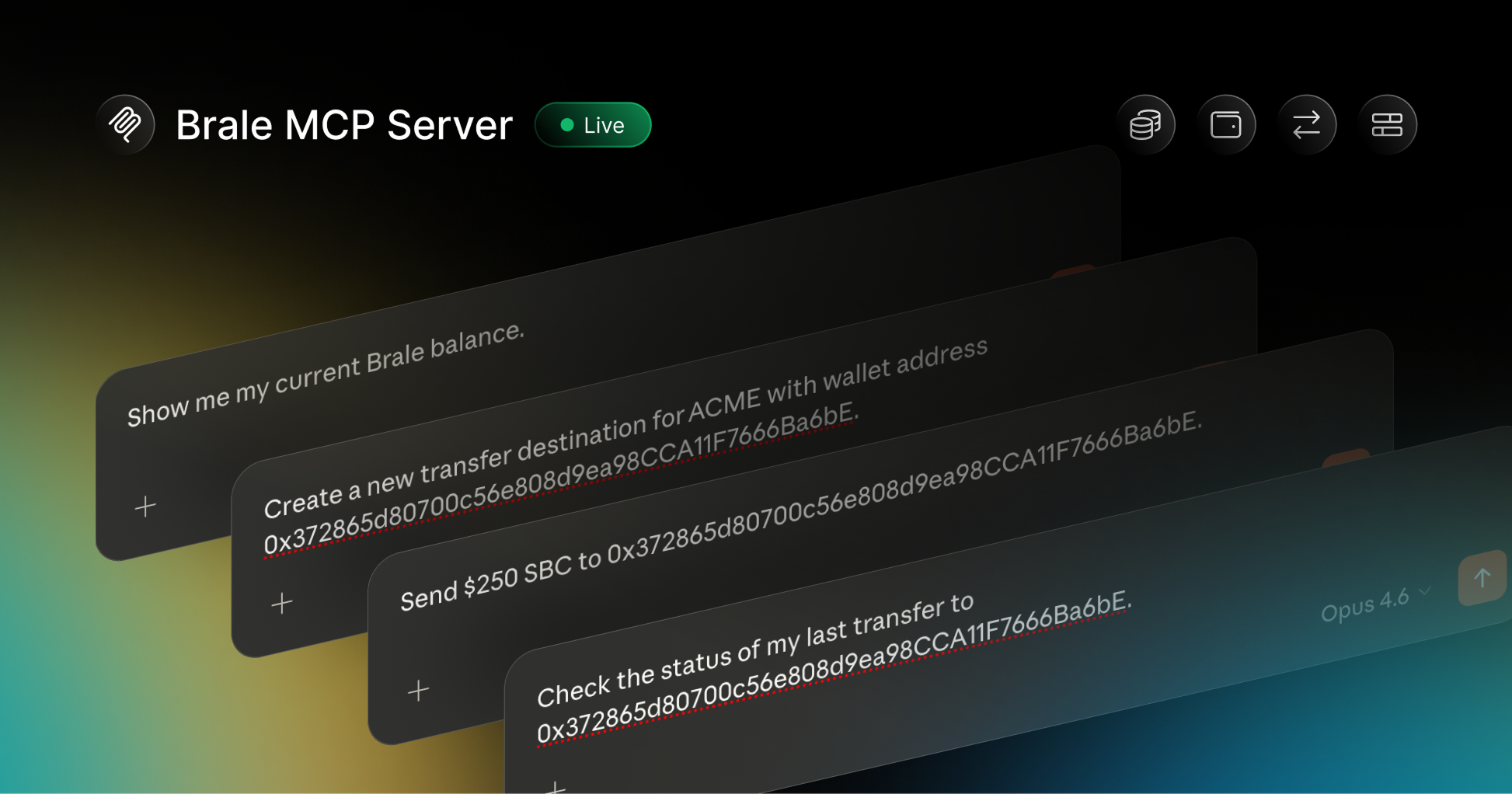
Try asking your MCP client:
Check my Brale balance
Create a new destination
Initiate a small transfer
Query transfer status
We designed the server to translate those requests into the appropriate underlying API calls and return structured results.
Less trial and error. Fewer malformed requests. Faster iteration.
Run stablecoin operations inside your dev environment
Developers are already working inside AI-native tools like Claude and other MCP-compatible clients.
Now you can run stablecoin operations directly inside those environments, shortening the debug loop and reducing support friction.
Instead of switching between documentation, API clients, dashboards, and logs, you can now check balances, validate transfer status, or create a destination without leaving your editor.
Common issues like balance discrepancies, transfer state confusion, or destination configuration can be quickly resolved by querying the live account state directly.
Building production stablecoin infrastructure?
If you're integrating Brale into internal tools, AI agents, or production systems and need regulated stablecoin issuance, custody, and banking connectivity ready for scale, get in touch.
What an agentic payment flow looks like
A typical payment interaction might look like this:
- Intent detection → “Pay this vendor $250 USDC.”
- Validation → Confirm available balance and verify the destination address.
- Execution → Initiate the transfer through the appropriate Brale API route.
- Verification → Query transfer status until settlement is confirmed.
- Record → Return structured results for logs, reconciliation, or audit.
With the MCP Server, each of these steps can be executed through a controlled interface to the Brale API directly inside your AI tooling.
How the Brale MCP Server is scoped for regulated infrastructure
Money movement infrastructure cannot be open-ended.
We intentionally limited version one of the MCP Server to a focused tool surface:
Check balances
Create addresses and destinations
Initiate small transfers
Query transfer status
To be clear, this is not unrestricted agent autonomy.
The Brale MCP server is built as a standalone bridge on top of Brale's public API. It does not bypass authentication, permissions, or account-level controls.
Access is handled through OAuth using your Brale API app credentials. You control the credentials, your existing limits still apply, and the MCP surface is intentionally scoped.
No parallel execution stack. No bypassed controls.
How to get started

Remote MCP Server URL:
https://mcp.brale.xyz/
Authentication: Use OAuth with a Brale API app
client_id
and
client_secret.
Full setup instructions are available in the API MCP documentation.
Version one focuses on read-heavy and low-risk operations. We'll expand the surface area deliberately based on how teams use it.
If you're building with MCP-enabled tools and want stablecoin infrastructure accessible inside your development environment, start here.
Contributors
- MSMadeline SeitzProduct Marketer
- Chris KnutsonSr Software Engineer